Voice Assistant for Private Clinics
An NTT DATA bootcamp on conversational AI and prompt design. Over 8 sessions I learned to understand, design, build, test, measure and plan the strategy of a conversational agent. With what I learned, I designed a voice assistant that lets patients of a private clinic book their appointments, and presented it at the final Demo Day.
Project Details
Location
Lima, Peru
Duration
5 weeks
Team
Individual project
Context
NTT DATA bootcamp (Conversational AI & Prompt Design)
Role
Conversation Designer
Challenge
NTT DATA presented the case of a private clinic whose phone line is overloaded with calls to book appointments, check lab results and cancel visits.
- Patients hang up because the line is saturated.
- The challenge: create an agent that not only manages the schedule, but also gives basic guidance based on medical protocols (using RAG) and handles the uncertainty of natural language when patients describe symptoms or needs.

Goal
G1
Present the solution in a 5-minute pitch at the Demo Day, in a clear, engaging and easy-to-follow way.
G2
Design a decision tree with branches for when no appointment is available.
G3
Design generative AI prompts with guardrails that prevent wrong medical diagnoses, backed by a knowledge base of the clinic.
G4
Plan an A/B test to improve the conversion rate.
Process
Each bootcamp session had a hands-on activity, and through them I built parts of the deliverables. At the end, I brought everything together into one proposal and looked for a creative way to present it in 5 minutes. The following sections explain how I built each deliverable.
Decision Tree
Before starting
I asked different people how they book medical appointments. I wanted to understand what information matters to them, which steps they follow and at what point they prefer to talk to a person.
Structure in FigJam
I split the flow into scenarios (what the patient says), steps, required data and possible outcomes: appointment booked, patient on the waiting list or handoff to a person.
Generative or deterministic AI
Following what we saw in class, I defined which parts of the flow use generative AI, such as understanding what the patient describes in their own words, and which are deterministic, such as checking availability or booking the appointment.
When to hand over to a person
- Urgent symptom
- Identity not verified
- The patient asks to talk to a person
- They want to reach a specific doctor's assistant
- Three unresolved attempts
Prompt with Guardrails
How I built it
I started from the prompt created in a class activity, which guided me through questions. For the final delivery, I added what the tool's checklist marked as missing and refined it with help from ChatGPT.
Handling symptoms
- If it's urgent, it connects the patient with a clinic assistant
- If it's not urgent, it helps them book so a doctor can assess them
- If it's ambiguous, it asks a single question to clarify: “How long have you been feeling this?”
Guardrails - Part 1
- Scope: appointment management only, never diagnoses
- Information: only clinic data and approved protocols; nothing made up or unverified
- Behavior: one question at a time, never asking again for data already given
Guardrails - Part 2
- Privacy: the ID number is requested only to book, and nothing is booked without a confirmed identity
- Transparency and escalation: it never confirms actions it didn't take, and hands over when it should
- Format and tone: clear, empathetic, helpful and brief
Knowledge Base
Clinic information
Specialties, doctors by specialty, locations, prices and accepted insurance.
Guidance protocols
High, moderate and low urgency criteria, and a guide from symptom to specialty. They guide, but never diagnose.
Operating policies
Cancellations and rescheduling, the waiting list, booking requirements, lab results and when to hand over to a person.
Patient history
Past appointments and saved preferences. Only consulted after verifying the patient's identity.
A/B Testing Plan
How I approached it
In class we learned how to compare a control with a variant before launching something new, and drafted a first test. With the feedback and my decision tree, I adapted the plan to the moment when there is no appointment on the requested date.
Finding and hypothesis
When there's no appointment, the agent only offers the next available date, which can be weeks away, and patients drop off or ask to talk to the front desk. If they can also join a waiting list for their preferred date, handoffs to a person should go down.
Control and variant
- A (control): only offers the next available date
- B (variant): books that date as a backup and adds the patient to the waiting list; if an earlier slot opens up, it lets them know
Measurement
- Main metric: handoff rate to a person at that point
- Secondary: drop-off, conversion and waiting-list conversion
- Sample: 800 conversations (400 per variant) over at least 14 days
- Guardrails: for example, no increase in manual work for the front desk
Demo Day Pitch
The problem
The existing digital channels may be insufficient for ambiguous requests, personal preferences, or lack of availability.
The proposal
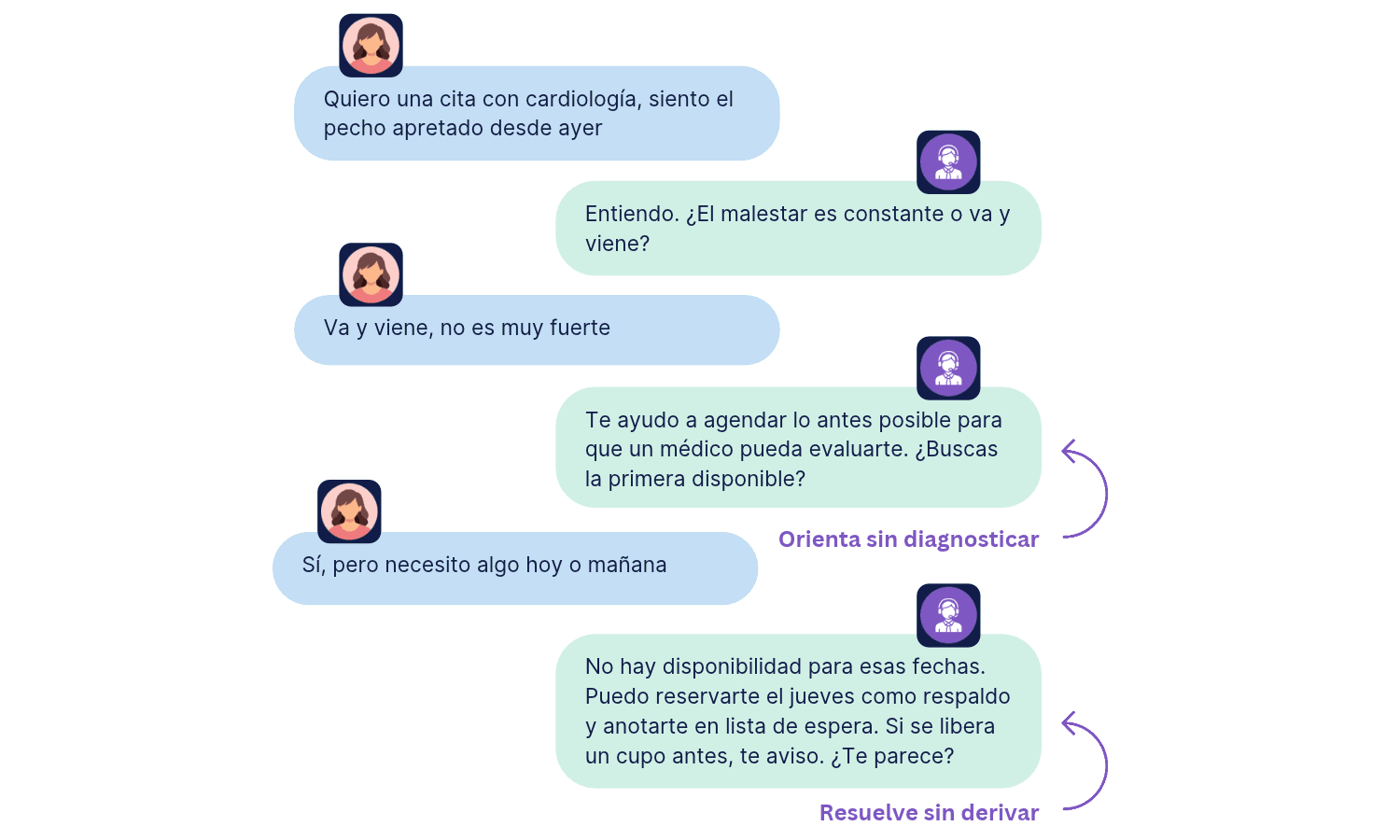
A sample conversation showing how the agent understands, guides and resolves.
The value
Less load on the call center, empty slots recovered, and the A/B test results as evidence.
Results
Key Findings
The Demo Day conversation sums up the proposal: an agent that understands natural language, never diagnoses, and resolves or hands over when it should. Faced with chest discomfort, it asks a single question, guides without diagnosing and looks for the earliest appointment. When there's no slot, it books a backup date and adds the patient to the waiting list instead of handing her over.
Simulated A/B test results
Conclusions
Main Conclusion
Voice agents will be used more and more, and the difference lies in how they're designed. Talking with other people about their experiences, I noticed that many reject voice agents because they've had bad experiences with bots that didn't understand them. If an agent is well designed, covers the different cases and has the knowledge needed to resolve people's questions, that perception can change. In healthcare, it also has to know what it must not do and when to hand the case over to a person.
Next Steps
- Test the agent with real patients to validate the tree and the tone.
- Run the A/B test with real data from the clinic.
- Extend the design to the case's other intents: cancelling or rescheduling, and checking lab results.
Key Learnings
- Separating what generative AI handles from what must be deterministic makes the agent more reliable.
- Guardrails and the knowledge base are what make it possible to guide without diagnosing.
- Presenting a solution to a client means telling the problem, the proposal and the value, not showing every deliverable.
Additional Materials
View the presentation
The pitch slides I presented at the Demo Day (in Spanish).
View presentation →Read the deliverables
The full document with the decision tree, the prompt with guardrails, the knowledge base and the A/B testing plan (in Spanish).
View PDF →Certificate
The certificate from NTT DATA's Conversational AI & Prompt Design bootcamp.
View certificate →Want to Learn More?
For questions about this project or collaboration opportunities, feel free to reach out.
Contact Me →