Digital Wave Form
A one-week UX challenge exploring how podcast content could be integrated into an existing AI-powered media monitoring platform.
Project Details
Location
Trento, Italy
Duration
One week
Team
6 members
Context
UX Challenge 2026
Role
UX Research
User Testing
UX Design
Challenge
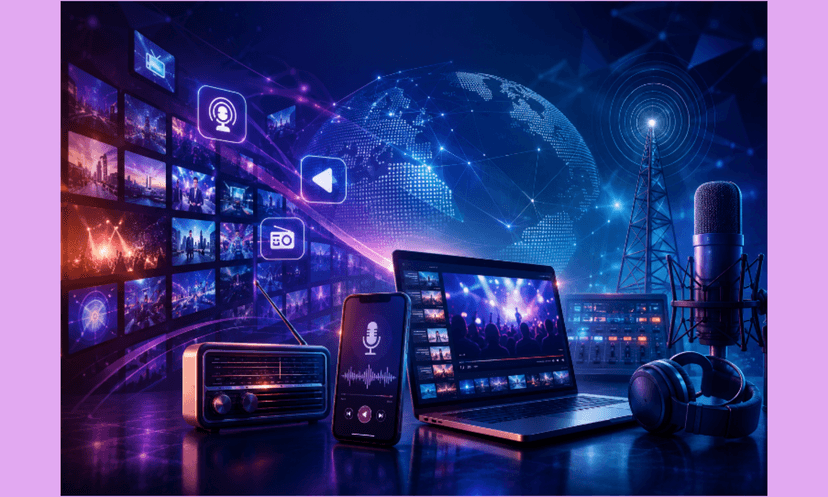
Digital Wave Form's A1 Monitoring platform helps users monitor and analyze media content from TV and radio. The challenge was to determine how podcasts could be integrated into the existing experience without introducing unnecessary complexity.
- Topics: Labels and keyword creation flows were not always clear.
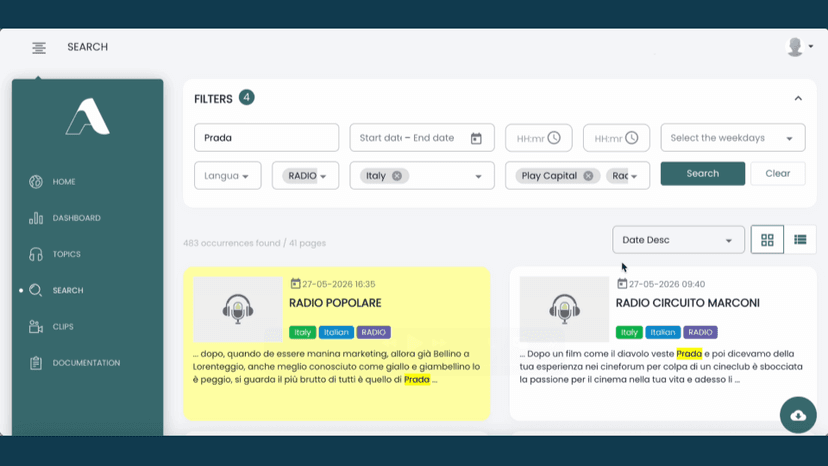
- Search: Search logic, Boolean operators, and filters were difficult to understand.
- Clips: Saved media was difficult to find, organize, and edit.
Goal
G1
Understand how podcast content differs from TV and radio.
G2
Determine how podcast content could be integrated into A1 Monitoring while supporting existing user workflows without adding unnecessary complexity.
Process
Before designing the podcast experience, we explored the existing platform and tested its main workflows to understand where podcast integration could introduce new needs and where existing usability issues should first be addressed.
Mapping the Problem
Platform Exploration
After the company kickoff, we explored A1 Monitoring to understand its information architecture and existing workflows. We focused especially on Topics, Search, and Clips, since these were the main areas where podcast content would need to appear.
Podcast Integration Questions
- Could podcasts use the existing media workflows or require a separate section?
- What information should be shown for a podcast episode?
- How should users search and filter podcast sources?
- How would longer podcast content affect media review and analysis?
User Testing
Testing Procedure
- 4 participants completed realistic tasks using the existing platform.
- Participants followed a think-aloud protocol while completing each task.
- A Single Ease Question (SEQ) was administered after each task.
- Sessions concluded with a semi-structured interview, SUS, and UEQ-S questionnaires.
Tasks
- Create and interact with a Topic.
- Search for media using keywords and filters.
- Review a search result, create and save a Clip, and explore its details.
SUS Score
- Mean score: 63.1 / 100.
- Falls within the "OK / D" usability range.
- Indicates that the platform was usable, but had important usability issues requiring improvement.
UEQ-S Score
- Pragmatic Quality: 0.00 — neutral.
- Hedonic Quality: +0.19 — slightly above neutral.
- Both scores were below the typical above-average benchmarks, indicating room for improvement in clarity, efficiency, and overall experience.
Key Problems Identified
Search Media
Users struggled to understand how to formulate searches, use Boolean operators, and navigate filters. Returning from results could also interrupt the active search.
Clip Management
Saved clips were difficult to discover and organize, while editing clip duration and understanding available actions were not always clear.
Podcast Integration
Podcast episodes introduced new needs such as longer-content summaries, episode information, subscriptions, and improved media-source navigation.
Results
Design Outcome
Instead of creating a separate podcast section, podcasts were integrated into the existing monitoring experience. We redesigned Topics, Search, and Clips, introduced Clip Gallery, and created a new Projects workspace for organizing saved searches, media, collaboration, and analysis.
3
existing workflows redesigned: Topics, Search, and Clip Gallery
1
new Projects workspace introduced for organizing active investigations
2
search modes introduced: Basic and Advanced
Conclusions
Main Conclusion
The challenge began by asking how podcasts could be added to A1 Monitoring, but our research revealed broader usability and information-organization issues in the existing experience. Rather than introducing another isolated workflow, we integrated podcasts into the existing media structure and redesigned the areas that users already relied on.
Future Work
- Test the redesigned prototype with a larger group of users and current DWF customers.
- Validate the Projects workspace and new information architecture through usability testing.
- Evaluate podcast workflows using real podcast datasets.
- Assess technical feasibility, scalability, licensing, and business requirements before implementation.
Key Learnings
- A feature request can reveal broader usability problems in the existing product.
- New content types do not always require entirely new workflows.
- Combining qualitative usability testing with standardized measures helped prioritize design problems within a very limited timeframe.
- Designing for complex professional tools requires balancing additional functionality with discoverability and cognitive load.
Additional Materials
High-Fidelity Mockups
Explore the complete set of high-fidelity screens designed for the proposed A1 Monitoring experience.
View in Figma →Final Presentation
Presentation used during the final UX Challenge event to communicate the research findings, design decisions, and proposed high-fidelity solutions.
View presentation →Final Report
Complete deliverable prepared for Digital Wave Form, including the usability study, identified issues, design decisions, and proposed solutions.
View report →Want to Learn More?
For questions about this project or collaboration opportunities, feel free to reach out.
Contact Me →