EQUILUNA
Equiluna is a 2D interactive video game designed to evaluate the effects of auditory, haptic, and combined audio-haptic feedback on balance control.
Project Details
Location
Trento, italy
Duration
3 months
Team
3 members
Context
University Project (Multisensory Interactive Systems)
Role
Research
User Testing
Game Development
Challenge
Traditional balance training has important limitations:
- Low engagement due to repetitive exercises
- Lack of real-time feedback on performance
- Difficulty in measuring progress

Goal
Goal
Create an engaging, measurable, and feedback-rich training experience.
Participants receiving audio-haptic feedback will achieve the highest accuracy scores.
Process
To address the identified gaps, we designed, developed, and tested a 2D videogame—EquiLuna—controlled by a custom-built balance board and enhanced with multimodal feedback. The following sections describe the architecture, implementation steps, and testing procedure.
Architecture Design
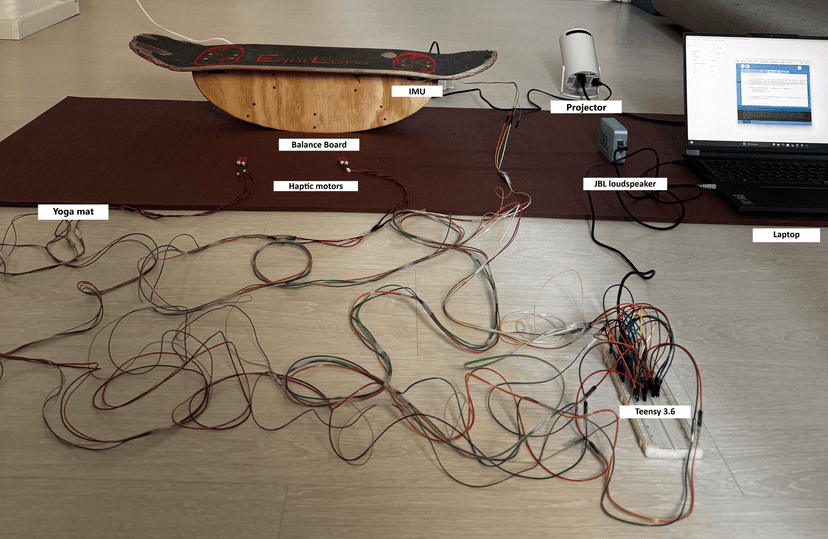
Hardware & Software Components
- Laptop running a game developed in Processing
- Sound synthesis engine
- Balance board with IMU sensors
- ERM haptic vibration motors attached to a belt
- Teensy 3.6 microcontroller
- JBL loudspeaker
- Projector for game display
Custom Balance Board
The balance board was crafted from a recycled skateboard deck and laser-cut wooden pieces at FabLab UniTrento. The IMU was placed beneath the board to capture left-right movements.
Usage Model
Trial Structure
Participants completed four trials with varying feedback conditions (no-feedback, haptic, auditory, multimodal).
Level Structure
Each trial has 4 levels: Tutorial, Simple path, Complex path, Curved path.
Sublevels structure
Each level has 3 difficulties: Normal speed, Increased speed, Distractor condition.
User Testing
Testin Procedure
- 16 participants (6 female, 10 male)
- Age average: 25.19 years
- Trials were randomized across participants to control for order effects.
- All participants experienced all conditions in a within-subjects design.
Measured Variables
- Accuracy: How often the astronaut remained within the path
- Similarity: How closely the astronaut’s movement followed the predefined path.
- Questionnaire developed to assess user experience of a VR balance training video game
Results
Key Findings
Multimodal feedback improved performance by 3% compared to no feedback, though it showed slightly lower similarity than unimodal conditions.
Similarity by Condition
50.65%
multimodal accuracy compared to 45.10% with no feedback
1st
multimodal feedback was the most preferred by participants
4.25/5
average rating for task ease with multimodal feedback
Conclusions
Main Conclusion
Both auditory and haptic feedback improved balance performance compared to no feedback, demonstrating that sensory guidance can support users during balance tasks. However, combining both modalities did not immediately produce better performance outcomes. Despite this, participants perceived multimodal feedback as the most helpful and engaging guidance method, suggesting that its effectiveness may depend on user adaptation and learning order.
H1 — Partially Supported
We hypothesized that multimodal feedback would improve balance performance due to multisensory integration. Results showed that auditory and haptic feedback individually produced the highest Accuracy and Similarity scores, while the combined condition did not outperform them overall. However, multimodal feedback improved when introduced after unimodal feedback, suggesting that users may need prior exposure to individual sensory cues before benefiting from their combination.
Design Implications
Participants who experienced multimodal feedback without prior exposure to unimodal feedback showed lower performance, possibly due to cognitive overload. This suggests that training systems could benefit from progressively introducing sensory modalities rather than presenting multiple cues simultaneously.
Future Research
- Test the system with a larger participant sample to validate the observed trends.
- Investigate adaptive sequencing of feedback modalities during training.
- Evaluate the role of visual feedback to better isolate sensory contributions.
- Explore long-term effects of multisensory feedback in repeated training sessions.
Key Learnings
- Auditory and haptic feedback can independently improve balance task performance.
- Multimodal feedback may require progressive exposure to avoid cognitive overload.
- User perception of helpfulness does not always align with objective performance metrics.
- Gamified rehabilitation systems can increase engagement in physical training tasks.
Additional Materials
Video demo
Watch EquiLuna in action with demonstration of all feedback modes.
Watch video →Publication
Full research paper published in the Proceedings of the 16th Biannual Conference of the Italian SIGCHI Chapter.
View paper →Slides from final presentation
Presentation summarizing the experimental design, results, and conclusions.
View presentation →Code Repository
Access the source code for the EquiLuna project on GitHub.
View repository →Report
Access the complete research report with detailed methodology, analysis, and findings.
View PDF →Want to Learn More?
For questions about this project or collaboration opportunities, feel free to reach out.
Contact Me →