Communication, Personality & Daily Stress
A diary-based research project investigating whether communication with close social ties at the start of the week influences students’ stress levels, and how personality moderates this relationship.
Project Details
Location
Eindhoven, The Netherlands
Duration
8 weeks
Team
4 members
Context
University research project (Network Society course)t
Role
Theory & Hypotheses Development
Statistical Analysis Support
Challenge
Digital communication is constant, but does more communication with close contacts reduce stress?
- Does communication with strong ties on Monday influence stress levels during the rest of the week?
- And does personality (introversion/extraversion) change this relationship?
The assumption from prior literature:
- Close ties buffer stress.
- Extraverts benefit more from social interaction.
- Introverts may experience overstimulation.

Goal
Goal
Examine short-term links between communication frequency and daily stress and test whether personality moderates this relationship.
Higher Monday communication will be translated into lower stress later in the week.
Effect stronger for extraverts, weaker or reversed for introverts.
Process
To study how communication patterns relate to daily stress—and how personality moderates this relationship—we designed a diary study, prepared and modeled the data, and interpreted the findings using mixed-effects analysis. The following sections summarize the research workflow.
Study Design
Diary Structure
5-day diary study with 42 students resulting in 198 day-level observations.
Daily Measures
Participants reported communication frequency with close ties and daily stress levels each evening.
Personality Measure
Extraversion was measured via baseline survey to test moderation effects.
Analytical Approach
Designed to test within-person effects of communication load on stress using multilevel modeling.
Data Preparation
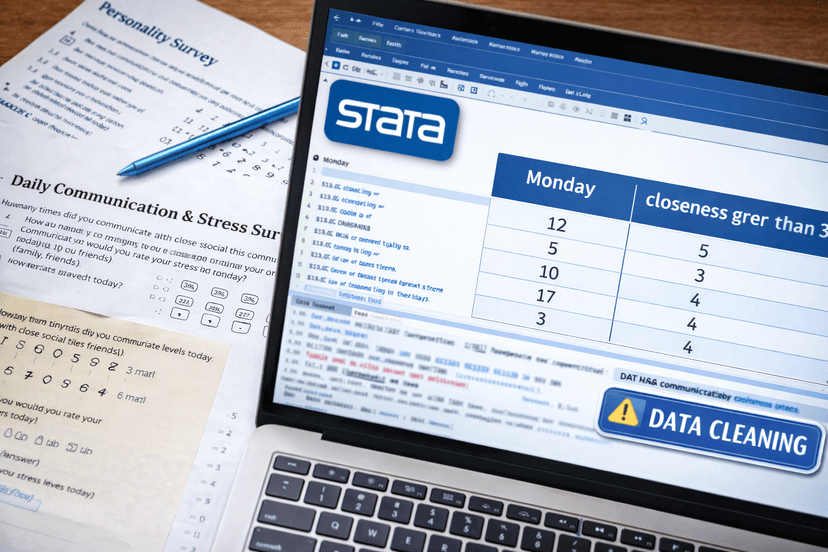
Cleaning & Feature Construction
- Data cleaning and recoding
- Strong ties filtering (>3/5 closeness)
- Aggregation of Monday communication load
Statistical Modeling
- Linear mixed-effects regression (Stata)
- Interaction analysis (communication × extraversion)
- Marginal effects computation
Modeling & Statistical Analysis
Mixed-Effects Modeling
We used linear mixed-effects models to capture within-person variation and account for repeated measures nested within participants.
Personality as Moderator
We tested whether extraversion moderates the relationship between communication load and daily stress (interaction effects).
Marginal Effects
Due to interaction complexity, we computed marginal effects to interpret how predicted stress changes across levels of communication and personality.
Outputs & Interpretation
What We Reported
- Model coefficients and confidence intervals
- Marginal effects to explain moderation patterns
- Clear interpretation in plain language (practical meaning)
Limitations Considered
- Short time window (5 days) and limited generalizability
- Self-report bias in stress and communication measures
- Potential confounds (e.g., workload, exams) not fully controlled
Results
Key Findings
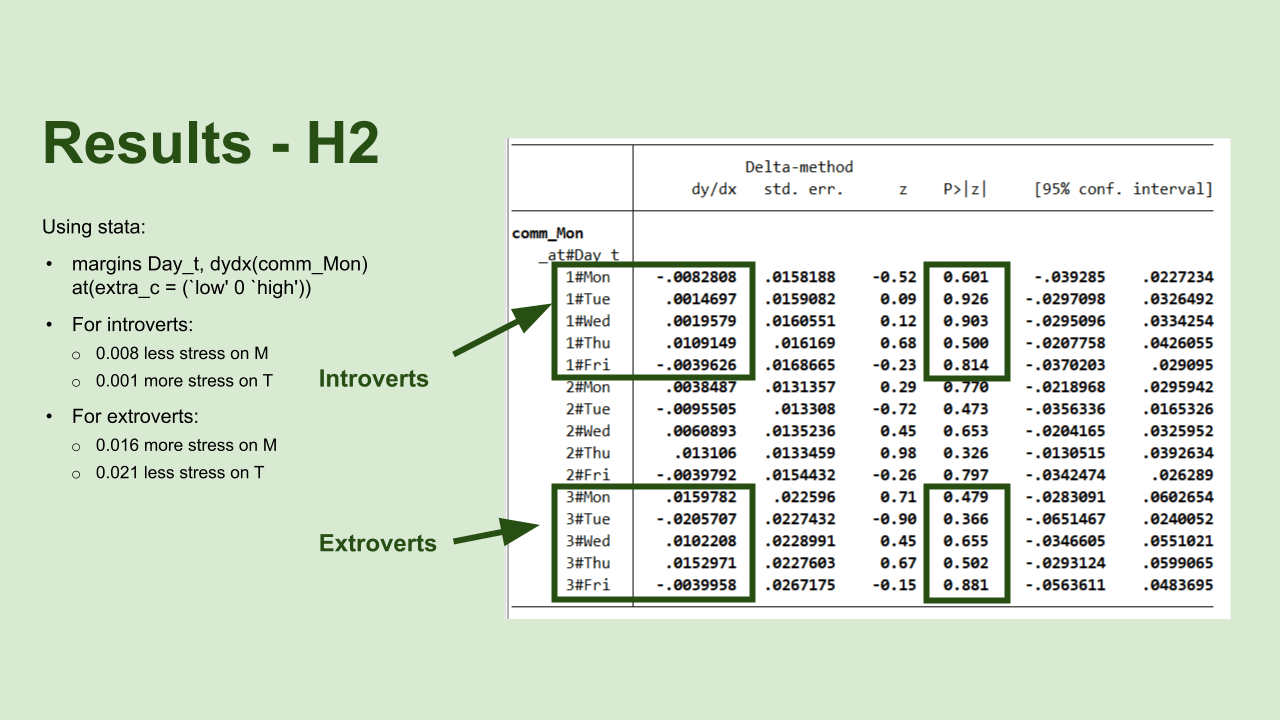
No significant relationship was found between Monday communication and stress during the week. Extraversion also did not moderate this relationship.
NO EFFECT
Monday communication was not significantly associated with stress levels across the week
SMALL
observed effects were limited and inconsistent across different days
NO MODERATION
extraversion did not significantly change how communication influenced stress
Conclusions
Main Conclusion
This study explored whether communication with close social ties influences daily stress and whether personality traits moderate this relationship. The results showed no significant relationship between Monday communication frequency and stress levels throughout the week, and no moderation effect of extraversion. These findings suggest that communication frequency alone is too limited to capture the complexity of social support and its impact on stress.
H1 — Not Supported
The hypothesis predicted that communication with close ties at the beginning of the week would influence stress levels during the following days. However, the analysis showed no significant relationship and effects were small and inconsistent across days. One possible explanation is that measuring communication only through frequency does not capture the quality, emotional content, or context of interactions.
H2 — Not Supported
The second hypothesis predicted that extraversion would moderate the relationship between communication and stress. The results showed no significant moderation effect, indicating that personality did not meaningfully change how communication frequency influenced stress in this dataset.
Future Research
- Incorporate measures of communication quality and emotional support rather than frequency alone.
- Analyze different communication channels separately (e.g., in-person, messaging, phone calls).
- Conduct longer diary studies to capture communication patterns over extended periods.
- Include more diverse stress levels to better evaluate the relationship between social interaction and well-being.
Key Learnings
- Communication frequency alone is insufficient to explain variations in daily stress.
- Personality traits may not strongly influence the relationship between communication and stress when interactions are measured only quantitatively.
- Diary study methods can reveal everyday behavioral patterns but require carefully designed measures.
- Social support is a multidimensional construct that should include quality, context, and emotional meaning.
Additional Materials
Final presentation
Access the complete presentation slides explaining the research process, analysis, and conclusions of the communication and stress project.
View presentation →Final report
Access the complete research report with detailed methodology, analysis, and findings of the communication and stress project.
View PDF →Want to Learn More?
For questions about this project or collaboration opportunities, feel free to reach out.
Contact Me →